Gresham Index · Research note #6 · September 2026
Entry price matters. That is exactly why you should not try to time it.
2026/09/09
A common piece of advice says the price you pay does not matter if you hold long enough. The arithmetic says otherwise. What is true is something narrower and more useful: entry price matters a great deal, and almost every attempt to improve it by waiting makes it worse.
Why the price you pay never stops mattering
Buy $1,000 of Bitcoin at $3,000 and you own 0.333 BTC. Buy the same $1,000 at $6,000 and you own 0.167 BTC. The ratio between those two positions is fixed at 2 to 1 and nothing that happens afterwards changes it.
| If Bitcoin reaches | Bought at $3,000 | Bought at $6,000 | Gap |
|---|---|---|---|
| $100,000 | $33,300 | $16,700 | $16,600 |
| $250,000 | $83,300 | $41,700 | $41,600 |
| $500,000 | $166,500 | $83,500 | $83,000 |
Holding longer does not close the gap. It widens it in dollars and keeps it identical in percentage terms. Anyone saying entry price stops mattering is describing a feeling, not a calculation.
What our own savers paid
We ran two rules over the same twelve years, both depositing every week, both starting in January 2014. Plain DCA puts in the same amount every week. Smart DCA scales the deposit with the Gresham Index: three times the base amount in the deepest zone, two times in the next, one time mid cycle, half above that, nothing once conditions stop being cheap.
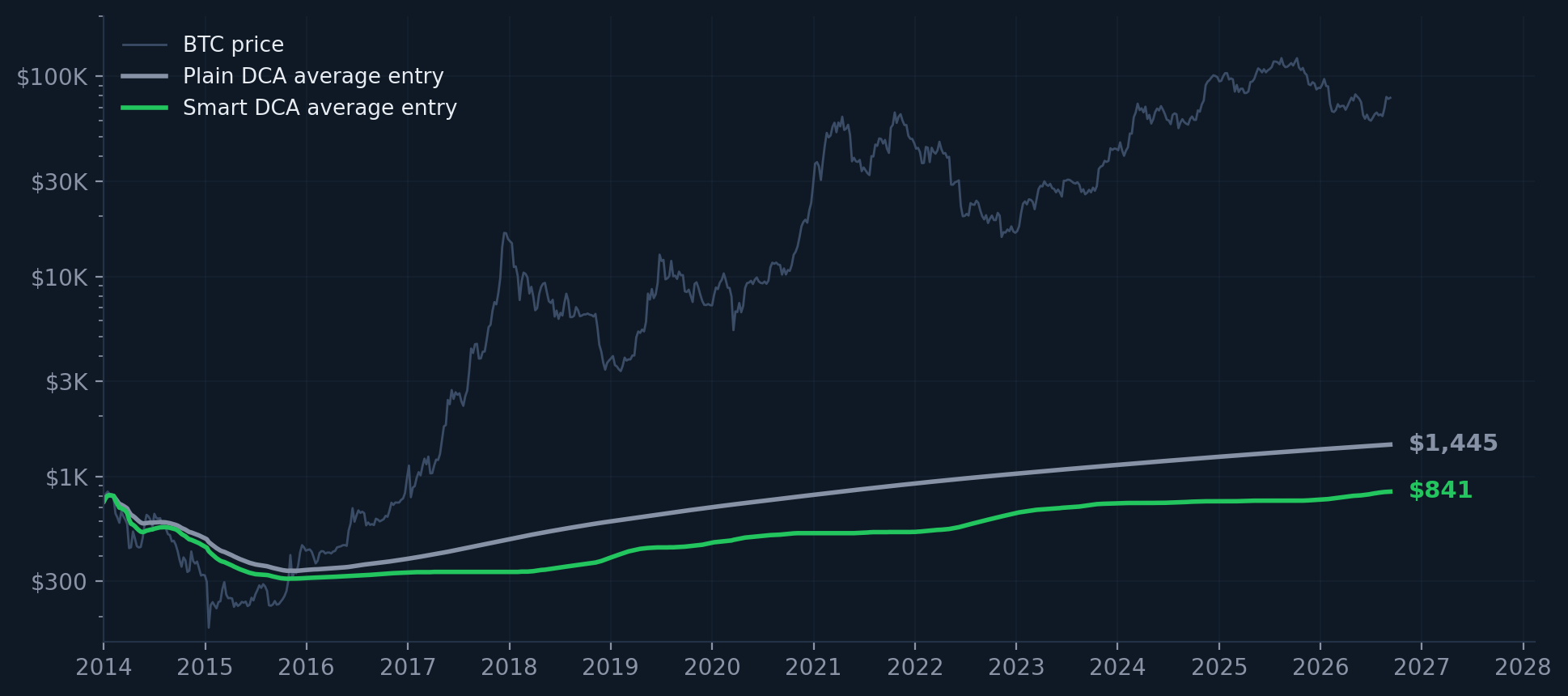
Figure — Running average entry price for both rules, 2014 to 2026. The gap opens during accumulation phases and holds through the rest. Weekly deposits, $100 base.
Now the part people skip
The obvious conclusion is to wait for a better price. We tested that directly, using our own index to define what cheap means. Save $100 every week, but only buy when the index reads below 0.30. Keep the cash until then.
WAITING FOR CHEAP LOST 26% — That rule skipped 464 of 663 weeks and finished with 33.9 BTC against 45.9 for simply buying every week. In money, $2.65m against $3.59m. Loosening the threshold to 0.50 still finished 5% behind. Our own metric, used to pick moments, lost to ignoring it entirely.
Being in the market beat being early. That is not a comfortable result for a company that publishes a cycle metric, and it is why we publish it.
Where the 42% actually comes from
This is the part that changes how you should read the first table. Smart DCA deposits more money in the cheap weeks, which means its total contribution over twelve years was $73,450 against Plain DCA's $66,300.
So we ran it again with the total held fixed. Same money in, same weekly saving, the only difference being when it gets deployed.
THE 42% BECOMES 4% — Holding the total constant, the average entry falls from $1,445 to $1,388. The advantage is almost entirely gone. The reason is simple: in the early years you have not yet saved enough cash to buy heavily, and the early years are when prices are lowest.
So the lower entry price is not a timing skill. It comes from actually depositing more in the stretches when depositing feels least rewarding. The index tells you when those stretches are. It does not find you a better price on money you were always going to invest.
One trap worth naming
While testing this we tried an obvious shortcut: take the known total and spread it across the weeks in proportion to what the index said. That produced the full 42% advantage with no extra money at all.
It is also impossible. Allocating a known total in proportion to future readings requires knowing the sum of all future readings on day one. We had built a rule that quietly used tomorrow's data, which is the single most common flaw in published backtests and the thing our whole method exists to avoid. The result went in the bin. The cash constrained version above is the honest one.
What to take from it
Entry price matters and it never stops mattering. The gap between a good average and a poor one compounds into a materially different amount of bitcoin for the same money.
The way to get a better average is not to wait. Waiting skipped two thirds of the weeks and cost a quarter of the outcome. The way that worked in this test was to keep buying always, and to buy harder when the measurement says conditions are cheap.
One caveat we will not hide behind. This is one asset over twelve years in which the price rose several thousand percent. In a flat decade these numbers would look different, and three cycles is a small sample for any claim about cycles.
Historical simulation of the frozen v1.0.1 specification, 2014-01-01 to 2026-09-09, weekly deposits, $100 base. Committed saver model unless stated otherwise; the fixed total comparison is cash constrained, meaning the strategy can only spend what it has already saved. Past results do not indicate future performance. Informational and educational only, not investment advice. Crypto assets are volatile; never commit money you cannot afford to lose.
Data: Coin Metrics Community Data, licensed under CC BY-NC 4.0. Modified: transformed into derived indicators and percentile ranks.